

How to Analyse an Instagram Account Before You Collaborate
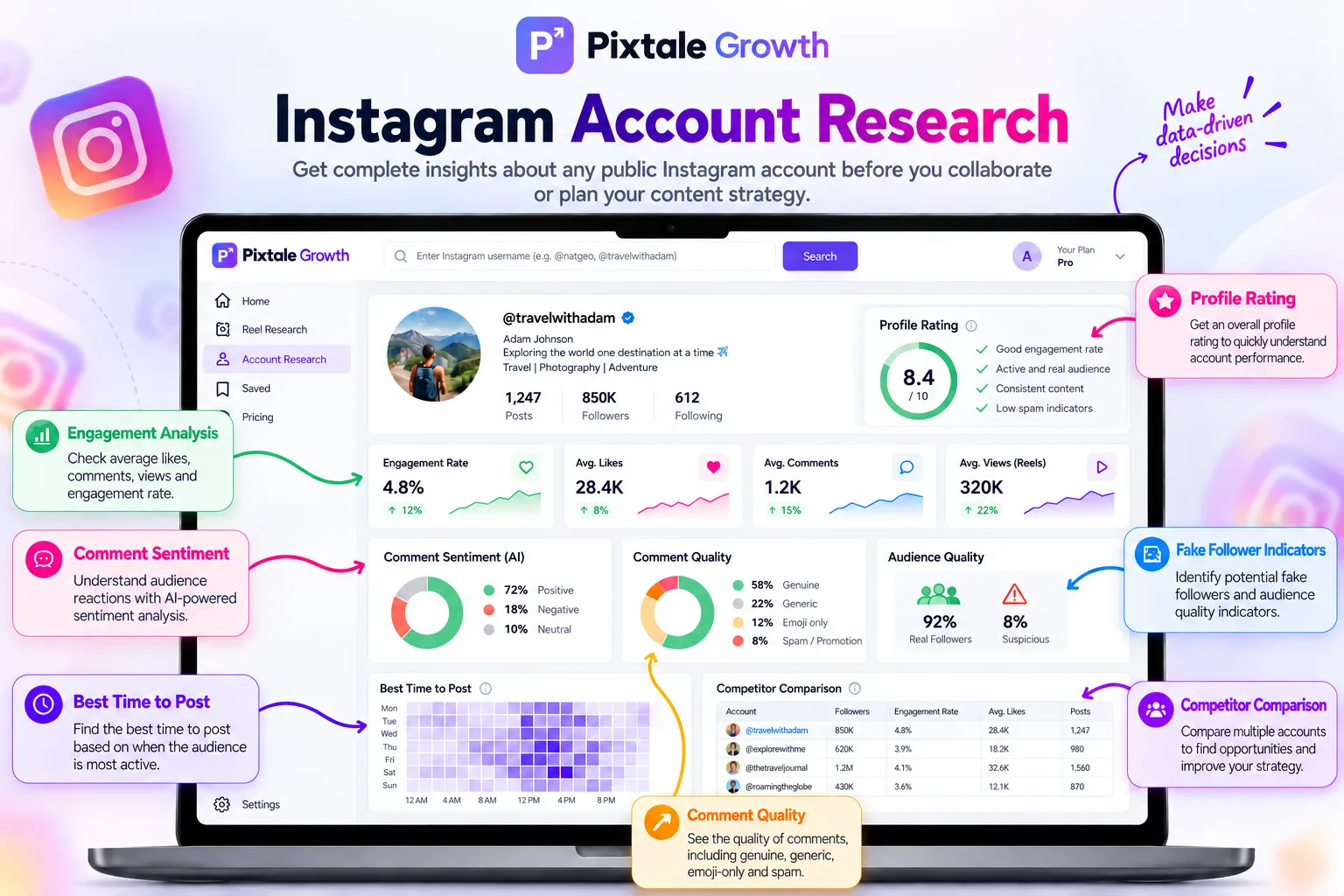
Learn how to analyse Instagram accounts using profile ratings, engagement, comment sentiment, audience quality, posting times, and competitor comparisons.
How to Analyse an Instagram Account Before You Collaborate
Choosing an Instagram influencer or planning a content strategy involves more than checking follower counts and likes. You also need to understand how an account performs, how its audience responds, and whether its content is relevant to your goals.
For brands, agencies, and creators, researching an Instagram account before making a decision can save time and provide useful insights.
But reviewing every post, comment, and engagement metric manually can be time-consuming.
This is where Instagram account research becomes useful. With the right analytics tools, you can evaluate profile performance, understand audience reactions, compare competitors, and identify areas that may need improvement.
In this guide, we'll explore what to check when analysing an Instagram account and how Pixtale Growth can help you make more informed decisions.
What Is Instagram Account Research?
Instagram account research is the process of examining a public Instagram profile to understand its performance, audience interactions, content strategy, and potential growth opportunities.
Instead of looking at just one metric, you evaluate several indicators together.
For example, when researching an influencer, you might want to know:
How does the account perform overall?
Does its engagement appear consistent?
What do people say in the comments?
Are there signs of potentially low-quality followers or interactions?
When does the account's content appear to perform well?
How does it compare with similar accounts?
These questions can help you understand an account more clearly before deciding whether to collaborate with it, learn from its strategy, or improve your own profile.
Why Should You Analyse an Instagram Account?
Different people research Instagram accounts for different reasons.
Brands and businesses want to assess whether a creator may be suitable for a campaign.
Influencer marketing agencies need a more organised way to review profiles and compare potential collaborators.
Content creators want to understand their performance, identify weaknesses, and learn from similar accounts.
Social media managers need insights that help them make better content and publishing decisions.
In each case, follower count alone is not enough. An account with a large audience may not be the best match for a particular campaign, while a smaller creator may have a more relevant audience and stronger conversations around their content.
A broader account analysis gives you more context for making that decision.
1. Check the Instagram Profile Rating
A profile rating can provide a quick overview of an account's performance based on the indicators supported by the research tool.
Instead of immediately reviewing dozens of individual metrics, you can start with an overall assessment and then investigate the details behind it.
When evaluating a profile, consider factors such as engagement, content performance, audience interactions, and consistency where the relevant data is available.
A rating is useful as a starting point, but it should not be treated as a definitive measure of an account's quality.
For example, two creators might receive similar profile ratings but have very different audiences, content styles, and business relevance.
Use the rating to guide your research, then review the underlying metrics before making a decision.
2. Analyse Engagement and Content Performance
Engagement helps you understand how people interact with an account's content.
Depending on the available data, useful indicators may include:
Average likes and comments
Engagement rate
Views on available Reels
Performance across multiple posts
Changes in visible engagement over time
Look for patterns rather than focusing on a single post.
For example, one Reel might receive significantly more views than the creator's other content. That could reflect an unusually popular topic, a wider distribution of the video, or other factors.
Similarly, an account with fewer followers may still receive meaningful comments and interactions from its audience.
The aim is to understand the account's broader performance rather than assuming that one number tells the whole story.
3. Understand Comment Sentiment With AI
Comments can tell you more about an audience than likes alone.
People may ask questions, share opinions, express excitement, or explain why they disagree with something in a post. Reading every comment manually can take time, particularly when researching several accounts.
AI-powered comment sentiment analysis helps organise these reactions into three broad categories.
Positive comments express appreciation, approval, excitement, or satisfaction.
Negative comments express criticism, dissatisfaction, disappointment, or disagreement.
Neutral comments may ask questions, share information, or express no clearly positive or negative opinion.
Pixtale Growth's AI Growth Advisor, available on Plus and Pro plans, analyses available Reel comments and provides sentiment insights.
Depending on the report, you can explore the percentage of comments in each sentiment category, sentiment for individual Reels, highly liked comments with sentiment labels, and a short AI-generated audience reaction summary.
These insights can help you understand how people respond to an account's content without manually reviewing every comment.
However, sentiment analysis does not prove whether a comment is genuine. A negative comment can be authentic, and a positive comment may offer little meaningful feedback.
4. Evaluate Comment Quality and Potential Spam
Sentiment and comment quality are different things.
Sentiment describes the tone of a comment. Comment quality looks at the type of interaction and how much useful conversation it contributes.
For example, a comment such as “Amazing 🔥” may be positive but contain little detail. A question about a product featured in a post may offer more context about the viewer's interest.
Pixtale Growth's Account Research includes comment quality analysis through its Audience Quality assessment on the Pro plan.
The feature estimates the proportion of comments associated with categories such as:
Genuine conversations
Emoji-only responses
Generic comments, such as “Nice pic”
Spam or promotional comments, such as “DM for collab”
It also displays a warning when estimated spam or promotional comments exceed 10%.
This warning is a signal to investigate further, not proof that an account is manipulating engagement. Real followers can also leave short comments, use emojis, or post generic compliments.
For a more balanced assessment, consider these estimates alongside engagement metrics, content relevance, and the wider context of the account.
5. Check Fake Follower Indicators
An account's follower count does not always explain the quality or relevance of its audience.
When researching an influencer, it can be useful to investigate whether the available audience data shows patterns that deserve a closer look.
Audience quality analysis may provide estimates or indicators related to potentially suspicious follower patterns, depending on the data available.
Use these findings as a reason to investigate further rather than treating them as a definitive verdict.
For example, an unusual combination of audience indicators and inconsistent engagement may justify a more detailed review. But an individual metric cannot establish that specific followers are fake.
Before collaborating with a creator, consider the complete picture:
The relevance of the audience to your brand
Engagement across multiple posts
The quality and relevance of comments
Consistency in content performance
Any available audience-quality indicators
This approach is more reliable than rejecting a creator based on one number alone.
6. Find the Best Time to Post
Publishing time is another factor creators often want to understand.
Posting when an audience is active may be worth testing, but there is no universal time that works for every Instagram account.
The best approach is to use available account data and test different publishing times with comparable content.
Pixtale Growth's account research experience includes best-time-to-post insights where supported by the available data.
These insights can help inform your publishing schedule, but they should not be treated as a guarantee of higher views or engagement.
Content quality, audience interests, distribution, and the subject of a post can also influence performance.
Use suggested posting times as a starting point, then compare your results over time to see what works for your audience.
7. Compare Instagram Accounts and Competitors
Competitor comparison can help you understand how similar accounts approach their content and where there may be opportunities to improve your strategy.
Start by identifying public accounts in your niche that target a similar audience.
Then compare available indicators, such as:
Follower counts
Engagement rates
Average likes and comments
Content performance
Posting patterns
Audience reactions
For example, if you manage a fitness account, you could compare it with other fitness creators to understand differences in visible engagement and content performance.
The objective is not to copy another account. It is to identify useful patterns, learn what your audience might respond to, and develop your own approach.
Pixtale Growth's Account Research can support this process by bringing relevant account insights into a more organised research workflow.
Remember that competitors may have different audiences, budgets, publishing histories, and content strategies. Their results should be interpreted in context.
How to Use Pixtale Growth for Instagram Account Research
Pixtale Growth is designed to help creators, marketers, brands, and agencies research Instagram accounts and understand available performance insights.
Rather than reviewing each indicator separately, you can use Account Research to explore several aspects of a profile.
Depending on your plan and the data available, the workflow includes:
Profile rating: Get an overall profile assessment.
Engagement analysis: Review supported engagement and content-performance metrics.
AI comment sentiment: Understand positive, negative, and neutral audience reactions.
Comment quality analysis: Explore estimated genuine conversations, generic comments, emoji-only responses, and spam or promotional comments.
Audience quality indicators: Investigate potentially suspicious follower patterns.
Best-time-to-post insights: Use available information to help plan your publishing schedule.
Competitor comparison: Compare accounts and examine their performance indicators.
Some features are plan-dependent. Comment sentiment analysis is available on Plus and Pro, while comment quality analysis through Audience Quality is available on Pro.
Watch the Pixtale Growth Account Research Demo
Want to see how the account research workflow looks in practice?
Watch the demo to explore how Pixtale Growth brings account insights together and helps you review Instagram profiles more systematically.
Watch the Account Research Demo on YouTube
Replace the placeholder above with your YouTube video URL before publishing.
You can also explore Pixtale Growth at https://thepixtale.com/.
What Should You Check Before Choosing an Influencer?
Before making a collaboration decision, use a simple checklist to keep your research consistent.
1. Profile relevance: Does the creator's content fit your brand and target audience?
2. Engagement: Are interactions reasonably consistent across multiple posts?
3. Comment sentiment: What kinds of reactions do the creator's Reels receive?
4. Comment quality: Are there meaningful discussions, or does the comment section contain many generic or promotional responses?
5. Audience quality: Are there any indicators that require further investigation?
6. Posting patterns: When does the creator tend to publish, and what can you learn from the available data?
7. Overall suitability: Does the creator's style, audience, and content align with your campaign goals?
No single score or metric should make the decision for you. Use account research to collect evidence, then apply your own judgement.
Common Mistakes to Avoid During Instagram Account Research
Even with analytics tools, it is easy to draw the wrong conclusions if you focus on the wrong indicators.
Judging an account only by followers: A larger audience does not automatically mean a better fit for your campaign.
Relying on one viral post: Compare multiple posts to understand typical performance.
Treating every generic comment as fake: Genuine followers often leave short compliments or emojis.
Assuming negative sentiment is bad: Constructive criticism and genuine questions can provide valuable feedback.
Trusting a rating without checking the details: An overall rating is a starting point, not a substitute for examining relevant metrics.
Copying competitors: Research should help you develop your own strategy rather than reproduce another creator's content.
A careful review helps you use analytics as evidence instead of treating estimates as facts.
Frequently Asked Questions
What is Instagram Account Research?
Instagram Account Research is the process of evaluating a public profile's performance, engagement, audience interactions, and content strategy to make better-informed decisions.
Can AI analyse Instagram comments?
AI can categorise available comments by sentiment and summarise common audience reactions. Classification may not always be accurate, particularly when comments contain sarcasm, slang, or limited context.
Can I identify fake Instagram followers using analytics?
Analytics tools may provide indicators or estimates of potentially suspicious follower patterns. These estimates cannot conclusively prove that a specific follower is fake.
What is the difference between comment sentiment and comment quality?
Sentiment describes whether a comment appears positive, negative, or neutral. Comment quality analysis estimates the type of interaction, such as meaningful conversation, generic comments, emoji-only responses, or promotional spam.
Does the best time to post guarantee more views?
No. Suggested publishing times can help guide experiments, but content quality, audience interests, and distribution also influence performance.
Who can benefit from Pixtale Growth Account Research?
Creators, brands, social media managers, and influencer marketing agencies can use account research to investigate public profiles, review available performance insights, and compare potential collaborators.
Final Thoughts
Instagram account research is most useful when you look beyond follower counts and consider the complete picture.
Profile ratings, engagement metrics, comment sentiment, comment quality, audience indicators, posting-time insights, and competitor comparisons can each provide a different perspective on an account.
Pixtale Growth brings these research capabilities into one workflow, helping creators, brands, and agencies make more informed decisions about Instagram profiles.
Use the insights as a starting point, verify important details, and combine the available data with your own judgement.
Ready to research an Instagram account? Visit Pixtale Growth and explore the Account Research experience.
Check any Instagram account free
AI rating, niche, engagement rate and top posts for any public profile. No login.
Analyse an account